Radio Facility Tour with Richard Dillman
Part of the On the Land series at Commonweal New School
Co-presented with the Maritime Radio Historical Society
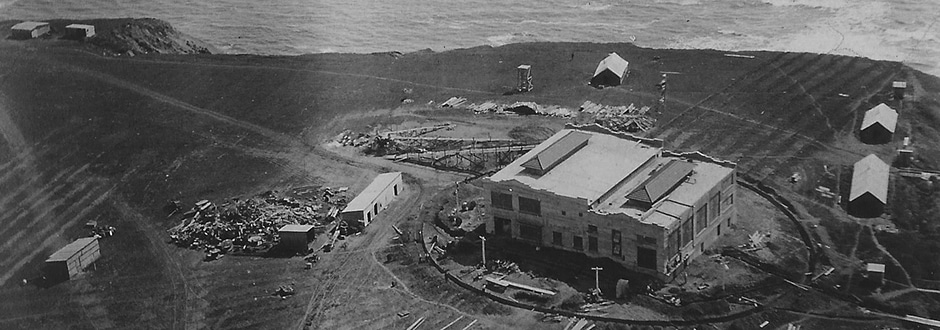
In February 1914 the American Marconi Telegraph Company began operating a powerful transmitting station on the Bolinas mesa, where Commonweal would be decades later. This station, along with its companion receiving station in Marshall, with its enormous spark transmitter of 230 kilowatts, reached across the Pacific to Hawaii and, later, to Asia. Telegrams were sent and received along this route in competition with the undersea cables which, until then, held a monopoly on intercontinental communications. In 1920 the Radio Corporation of America (RCA) absorbed the Marconi company and replaced the spark transmitter with two even more powerful machines known as Alexanderson alternators. In that same year RCA added Morse code ship to shore service at the site using the famous call letters KPH.
Today these transmitters, some more than 80 years old, can be seen in full-throated action, communicating with ships at sea as KPH has always done. The Bolinas site is the only place remaining in the world where a fully operational Morse code coast station from the golden age of radio may still be seen in action.
As part of Commonweal’s 50th anniversary year celebrations, please join the Maritime Radio Historical Society’s Richard Dillman (call name W6AWO), for this tour of the radio facilities in the “back half” of the Commonweal main building.
Image: The Marconi transmitting station (which would become Commonweal) being constructed in 1912. Courtesy: Maritime Radio Historical Society.
Saturday, June 27
1 pm – 2:30 pm PDT
On the land at Commonweal
Donations welcome
In person event only
***Event registration is full, register for the waitlist***
We will schedule more “On The Land” events soon!
Saturday, June 27
1 pm – 2:30 pm PDT
On the land at Commonweal
Donations welcome
In person event only
***Event registration is full, register for the waitlist***
We will schedule more “On The Land” events soon!

Maritime Radio Historical Society
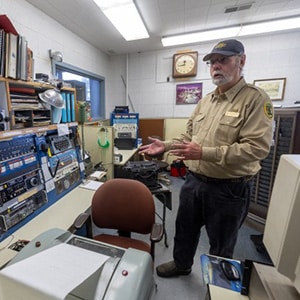
The Maritime Radio Historical Society was formed on July, 12, 1999, by Tom Horsfall and Richard Dillman, and is composed of a small group of dedicated individuals committed to the restoration and preservation of the artifacts of our maritime radio history. In 1999, Tom and Richard resolved that the tradition of commercial maritime Morse code could not be relegated to the dustbin of history. Upon visiting the Bolinas station, they were amazed to find not the vandalized sites they expected but instead an intact radio time capsule, with the receivers still on, maintaining a watch on the Morse calling channels. Their mission became clear: form an organization to repair, restore, and operate station KPH as a way to honor the men and women who for 100 years had made the profession of radiotelegrapher one of honor and skill. With trust and vision that are still amazing to think about, the Park Service gave these two radio squirrels, previously unknown to them, the go-ahead. Since then the MRHS has succeeded beyond what Tom and Richard thought possible in their wildest dreams. Not only has KPH returned to the air but so has KSM, KFS and K6KPH. Find out more about the “Bolinas High Power” radio stations of the San Francisco Bay Area.
The Rematriation of Science: Restoring Balance through Indigenous Knowledges | Part 2

The Rematriation of Science: Restoring Balance through Indigenous Knowledges | Part 1
Eternal Song: Echoes of Resilience Across Indigenous Worlds