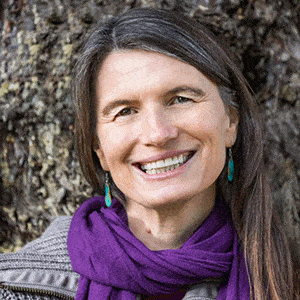
It is said that an arrow can only be shot by pulling it backwards, so the invitation to spend time at Commonweal New School is a compelling opportunity to rest, reflect, and be inspired at the fertile edge of the Pacific. As the masterful and experimental writer Kurt Vonnegut once said, “I want to stand as close to the edge as I can without going over. Out on the edge you see all the kinds of things you can’t see from the center.”
In ecology, an ecotone is where two or more ecosystems converge, creating uniquely blended habitats that are often higher in biodiversity, a phenomenon often called the “edge effect.” As a multi-ethnic person and transdisciplinary scholar-activist, I am enthralled by and feel at home on the edges. I am an Indigenous ecologist infused with an Anishinaabeg way of knowing, a complex relationship with Western science, and a love of wisdom traditions about how humans live with and regenerate the beauty and diversity of our shared home, planet Earth, especially during this time of the polycrisis.
So, the opportunity to spend time on the edge of the Pacific Ocean and Turtle Island along the San Adreas faultline on the traditional territory of the Coast Miwok peoples is deeply inspiring. To do this on the campus of the Commonweal provides a fertile habitat for reflection, engagement, and deep inquiry into the human-nature matrix. I look forward to listening to the land and sea, and the beings that reside there, and to the dynamic and maverick intellectual community of Commonweal.
For my residency, I will be focusing on a new research project I am developing, Rematriating Science, a multi-media and multi-vocal research-art-action project focused on returning to and revitalizing the Indigenous and feminist roots of science by highlighting ways of knowing that are based on epistemologies of care, belonging, kinship, and respectful intimacy with the natural world and each other. I propose this goal as an intervention for creating transformative social change to effectively address the epistemic roots of our polycrisis, specifically the damages to the natural world, and to thus Indigenous peoples’ lifeways and the well-being of all of us.
This work is based on a few key assumptions: 1) that the polycrisis is a result of fragmented thinking that creates incoherence and destruction; 2) that our collective future depends on rematriating the wisdom of Indigenous peoples, women, and nature’s intelligence; and 3) that rematriating science can engender a kinship consciousness to help us re-member and create a new paradigm of justice and well-being for “all our relations.”
In this project I seek to transform the reductionistic, fragmented, and technologically focused approach of most Western sciences and uncover hidden assumptions and tacit infrastructures that perpetuate stereotypes, social structures, and power dynamics that marginalize Indigenous peoples’ and women’s knowledges in the sciences. This project seeks to address the historic, contemporary, and epistemic injustices of Western science that displays little recognition for the sophistication of Indigenous and women’s scientific knowledges. I am interested in finding innovative and creative ways to compost patriarchal power and uplift the knowledges and actions of Indigenous and women scientists who are leading local, national, and global research and movements for biocultural conservation, sustainable design, climate and food justice, traditional medicine, and the rematriation of ancestral lands.
A key part of this project is accessing and unleashing creative imagination through deep listening, narrative storytelling, dialogue, dreaming, and artmaking. With a small research team based out of Arizona State University (ASU), and with seed funding from the ASU Create the Change Initiative, three short narrative podcasts and three posters are being created as the seed origins of the project to seek larger community input and insight.
I look forward to sharing more about these ideas in a live podcast interview September 29th with Jaune Evans, a long-term friend and collaborator on followed by an experiential workshop. This event will be a type of collaboratory to explore: What does a rematriated science look like to you? How can a rematriated science address the roots of the polycrisis? Can society move beyond an anthropocentric, male-dominated science to a relational one rooted in justice and care? What does that look like in your field or life?
I look forward to getting to know the Commonweal community and spending time, listening, on the land.